


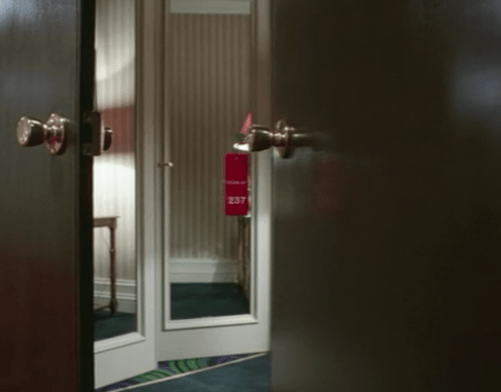
I’m never going to be able to appreciate films on the level that others seem to. I’m not one to see hidden themes or abstract moments and what they mean in a higher level. I’m also not great at noticing when a movie’s story may be referring to something else, commenting on a past event or even a situation in the world today. That is why I was looking forward to seeing what commentators in the movie Room 237 had noticed about Stanley Kubrick’s iconic movie, The Shining.
What I realised is that people will see whatever they want to. This isn’t a movie showcasing the hidden messages and themes within The Shining but rather a film that focuses on the almost obsessive way in which people analyse movies and attempt to prove their often bizarre theories.

To it’s credit, the film starts strongly with a very plausible theme, or at least solid message. The theory that the movie is about the slaughter of the Native Americans in the USA’s past holds some plausible weight, particularly when certain elements and key scenes are highlighted. There is something there, even if it doesn’t seem to make much impact or have much reason behind it.
Unfortunately, it soon becomes apparent that other people really have stretch credibility to make their theories fit. The theories range widely from the movie being a confession about how Kubrick faked and was responsible for the moon landings to the film being Kubrick’s comment on the Holocaust. To prove these theories, the commentators then focus on some of the most inconsequential aspects of the movie.

I won’t list them all here but one key example is the amount of interest and credit that people give to continuity errors. Any movie has a host of inconsequential continuity errors that most people don’t notice, let alone pay any sort of credible attention too. Here, every error is seen as some sort of attempt to deliver a message. Rather than admit that maybe even Kubrick can make mistakes, they have to read it as a very well hidden meaning.
The other example of how obsessed people become is the lengths that they have gone to to highlight their theories. For example, one person has watched the film in slow motion, attempting to analyse every single frame and find meaning. Another person watched the film backwards, overlapped with the film forwards, to see what the outcome would be – then spotting and noting coincidental moments.

It’s the fact that these moments are so coincidental that kills the theories presented in Room 237. The first theory, about the Native Americans, held some weight, albeit still quite abstract. The lengths of disbelief and faith you must employ for other theories makes me wonder how, or why, people want to see these things.
Obsessions and theories aside, one question I found myself asking was “why would Kubrick bother?” Making a movie isn’t easy, particularly one involving the elements that The Shining does. Some of these theories require such perfect timing of moments or creation of scenes that you wonder why he would bother when most people wouldn’t actually notice. If Kubrick wanted to confess to being responsible for faking the moon landings – make a movie about faking the moon landings! If Kubrick wanted to make a comment on the Holocaust – make a movie about the Holocaust.
Overall, what I learnt from Room 237 isn’t that Kubrick managed to hide a host of varying messages within The Shining, but that people are willing to go to obsessive means to prove that those messages are there. Aside from a few, slightly plausible theories, most of the commentators are forced to give Kubrick far too much credit and also impossible abilities as a film maker to prove their conspiracies. What one person will see as a hidden theme on the Holocaust, I will always see as simple, inconsequential continuity error.
Rating – 2
(1 – Awful, 2 – Average, 3 – Good, 4 – Great, 5! – Must See)
 Distinct Chatter
It’s sometimes quite interesting. Other times, a tad bit far-fetched. Good review.
Yeah, it was a very weird documentary with some things not making sense at all. Just shows that whatever you believable, there is always “evidence” to support it.